Solve Any Dutch Crossword: Essential Guide to Word Length & Clues
Dutch crossword puzzles, or kruiswoordpuzzels, offer a delightful mental workout, combining linguistic precision with general knowledge. However, even the most seasoned puzzlers can hit a wall. When faced with a perplexing clue or a tricky letter pattern, knowing how to effectively leverage online helpers becomes an indispensable skill. This guide will walk you through mastering Dutch crosswords, with a special focus on word length, clue interpretation, and making the most of digital tools to find that elusive answer.
The Indispensable Role of Online Dutch Crossword Solvers
Gone are the days of flicking through weighty dictionaries or poring over old encyclopedias. Modern online crossword solvers have revolutionized how we tackle Dutch puzzles. These digital powerhouses, often referred to as 'puzzelwoordenboeken' (puzzle dictionaries) or 'online helpers,' house extensive databases of over half a million Dutch words. They are specifically designed for the unique challenges of crosswords, offering features far beyond what a standard dictionary provides.
Their primary advantage lies in their speed and tailored search capabilities. Instead of simply defining words, they help you discover them based on partial information – precisely what you need when most of the letters are missing. Whether you're wrestling with a standard crossword, a challenging cryptogram, or a spatial Swedish puzzle (Zweedse puzzel), these tools are your best friend. They transform frustration into triumph by presenting possible solutions that fit your specific criteria.
Mastering Your Search: Leveraging Clues and Word Length
The key to unlocking solutions with an online helper lies in intelligent searching. It's not just about typing in the clue; it's about strategic input that maximizes your chances of a match.
1. Start with the Clue, but Be Flexible
Your first instinct should be to type the exact puzzle description into the search bar. Often, this direct approach yields immediate results. However, if your initial attempt comes up empty, don't despair! This is where strategic rephrasing comes in. Online solvers thrive on keywords, so avoid overly elaborate descriptions that might limit potential matches.
- Broaden Your Terms: If a clue is "Onderdeel van een omafiets" (Part of a granny bike), a more effective search might be the broader "fietsonderdeel" (bicycle part). This cast a wider net, increasing the likelihood of a match.
- Rephrase and Invert: Don't just stick to the puzzle's exact wording. If you're looking for a "plaats in Friesland" (place in Friesland), also try "Friese plaats" (Frisian place). Similarly, for "stam in Afrika" (tribe in Africa), search for "Afrikaanse stam" (African tribe). This subtle shift can be the difference between being stuck and moving forward.
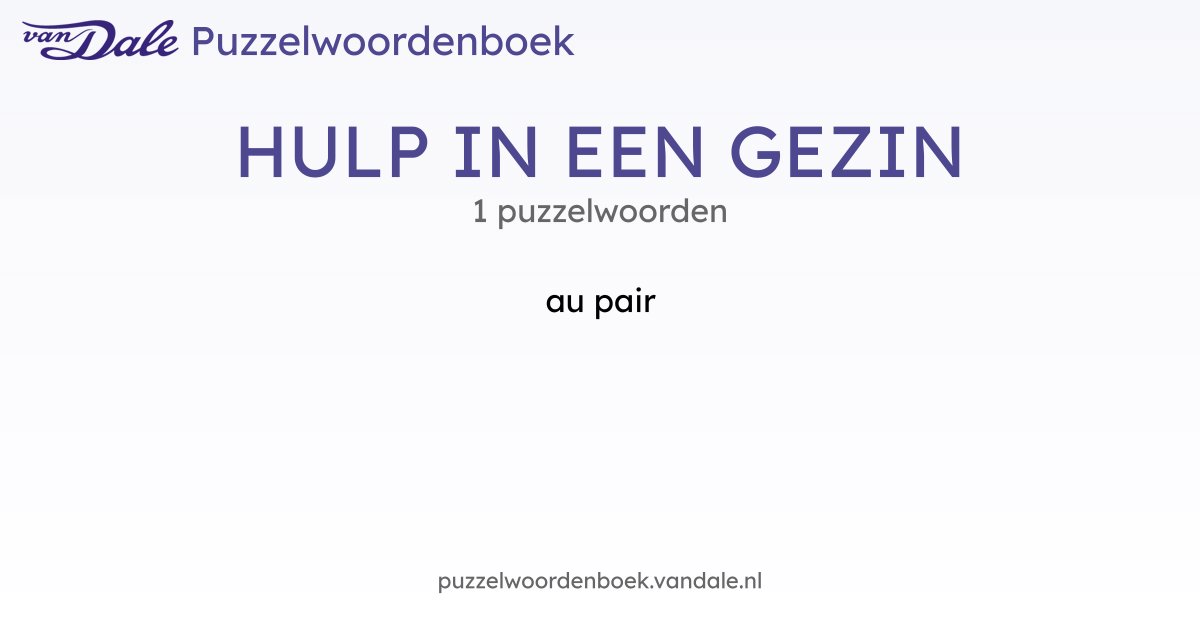
- Target Specific Keywords: Consider the essence of the clue. If you have a clue like "Hulp in het gezin" and you know it's a 6-letter word, you might start with a direct search for "Hulp in het gezin 6 letters". If that doesn't work, break it down. Perhaps try "gezins hulp 6 letters" or "huishoudelijke hulp 6 letters" to explore related concepts. This technique is particularly effective for finding specific terms or professions that might fit.
2. The Power of Word Length
One of the most powerful filters at your disposal is word length. Specifying the number of letters your answer should contain drastically narrows down the search results, making it infinitely easier to spot the correct solution. While most online helpers allow you to search without a specified length, doing so will present you with an overwhelming number of possibilities, making your search inefficient. Always use the letter count if you have it.
3. The Peculiar Case of 'IJ' vs. 'Y'
A unique aspect of Dutch linguistics that affects crosswords is the letter combination 'IJ'. In many Dutch crosswords and dictionaries, 'IJ' is treated as a single letter (or 'digraph') for display purposes, even though it occupies two squares in the grid. Online helpers intelligently manage this: a word like 'BLIJ' (happy) will be correctly displayed as 'BLIJ' but will appear in results for three-letter words, treating the 'IJ' as two separate characters for length counting, yet simplifying the search if you happen to type 'BLY'. This attention to detail ensures accuracy and user convenience.
Strategic Pattern Searching: Beyond Just Clues
Often, you'll have a few letters already filled in from intersecting words. This partial information is gold! Online helpers excel at using these patterns to pinpoint solutions.
1. Using Letter Patterns and Wildcards
Most advanced solvers allow you to input patterns using underscores or other wildcards for unknown letters. For instance:
_ _ E _ _: Searches for 5-letter words with 'E' in the third position.A _ _ _ _: Finds 5-letter words starting with 'A'._ _ _ _ N: Locates 5-letter words ending with 'N'.S _ _ _ _ _: Discovers 6-letter words beginning with 'S'.
Combine these patterns with word length filters, and you can quickly narrow down hundreds of thousands of words to a manageable handful. This is especially useful for unlocking Dutch crossword solutions through smart search & pattern strategies.
2. Actionable Tips for Solving
Beyond the tools, a few strategic habits can significantly improve your crossword solving prowess:
- Begin with Shorter Words: The 2- and 3-letter words are often the easiest to guess. Solving them provides crucial intersecting letters, which then act as vital clues for longer, more complex words.
- Identify Common Endings: Dutch has several frequent word endings. Keep an eye out for patterns like -EN, -ER, -ING, and -HEID. If you have a word ending in `_ _ _ _ E _`, you might anticipate -EN or -ER.
- Leverage Intersecting Words: Every letter you confirm from one word becomes a clue for another. Systematically fill in known letters and re-evaluate your potential solutions.
- Think Thematically: Many crosswords, especially in daily newspapers, have an overarching theme. Identifying this theme early can give you a significant advantage in guessing related words.
- Check for Plurals and Singulars: If a singular word doesn't fit the letter count or clue, try its plural form (and vice-versa). This is a common trick in puzzle setting.
- Explore Synonyms: Don't get fixated on a single interpretation of a clue. Brainstorm synonyms or closely related concepts in Dutch.
Overcoming Common Obstacles in Dutch Crosswords
Even with the best tools and strategies, some aspects of Dutch crosswords can be particularly challenging:
- Difficult Letters: Just like in English, some letters are harder to place in Dutch. Q, X, and Y are notoriously tricky because fewer Dutch words begin or contain them. If you get one of these, it's often a critical breakthrough. Remember the 'IJ' rule as well; while it counts as two letters, its unique nature can sometimes trip up solvers not familiar with the convention.
- Regionalisms and Archaic Words: Older puzzles or those from specific regions might use less common words, local dialect terms, or words that have fallen out of everyday use. Online helpers with vast databases are particularly good at finding these.
- Cryptic Elements: While this guide focuses on standard crosswords, some Dutch puzzles might incorporate cryptic clues. These require a different approach, often involving wordplay, anagrams, and double meanings. For more advanced techniques, you might want to explore articles like Master Dutch Crossword Puzzles: Expert Tips for Online Helpers.
Solving Dutch crosswords is a rewarding hobby that sharpens your linguistic skills and general knowledge. By combining the power of modern online helpers with smart search strategies, an understanding of word length, and a few clever solving tips, you can tackle even the most daunting kruiswoordpuzzels. Don't be afraid to experiment with your search terms, leverage every letter you uncover, and soon you'll be solving Dutch crosswords with newfound speed and confidence.